
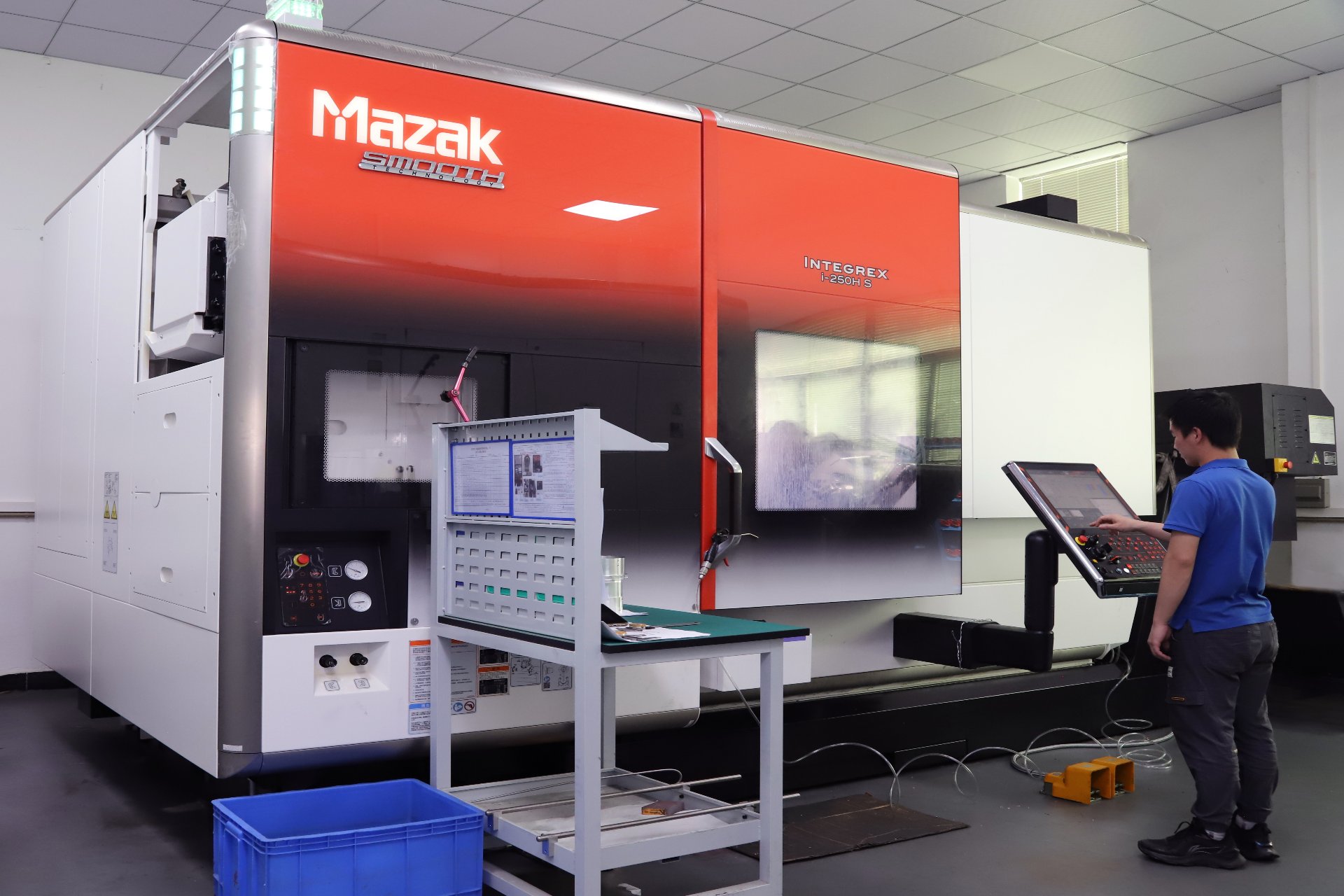
Precision CNC machining lead times are quoted in tiers of roughly 3, 7, or 30 days, and the tier is set by the work — the process steps, the finishing, and the inspection that the drawing demands. On a precision part, the drawing also decides how short the tier can be: a design optimized for manufacturability runs fewer operations and inspects faster, while a drawing that fights the process carries every extra step into the schedule. This guide walks the tiers, the step that owns the date, and the drawing discipline that moves a part to the faster end of its tier.
Why is a precision machining lead time quoted as a tier rather than a date?
A meaningful date has to be built from the work, and the work is counted at quoting. A three-day part is simple — a few operations in a standard material with no finishing beyond the cut surface. A seven-day part is the typical order: more features, more operations, standard inspection, perhaps a light finish. A thirty-day part is the complex route: many operations, tight callouts, surface finishing or heat treatment, and an inspection that takes real time. Each added step is a setup, a run, and an inspection point that a shorter window cannot absorb.
The tiered quote is the honest form of a lead time because it names the workload behind the date. A shop that quotes one flat lead time for every part has not counted the steps; one that quotes a tier with the routing explained has. The DFM review at quoting is where the steps are counted and the tier is set, which is why the review comes before the date. When you ask what moves a part to a faster tier, the answer is usually a step the drawing does not need, and removing it is the honest way to shorten the schedule.
How does design for manufacturability move the date?
A DFM-optimized part is a faster part before the machine ever starts. Tolerance applied only to the critical features keeps the finishing passes and the metrology on the features that matter; walls thick enough not to deflect cut without rework; the largest allowed internal radii let standard tools run at speed instead of slowing for tight corners; and limited hole depth avoids the slow, deflection-prone cuts of deep features. Each of these drawing choices removes or accelerates an operation, and on a precision part every removed operation is schedule recovered.
The DFM review is where those choices surface. A review that reads your drawing and flags the dimensions that cannot be held, the features driving cost, and the changes that would move the part to a faster tier is engineering your schedule as well as your quote. When the review recommends a wider radius or a relaxed tolerance on a non-critical feature, it is not asking you to lower quality — it is asking whether that feature earns the process time it consumes. A drawing revised on DFM feedback ships on the shorter end of its tier, and a drawing that ignores the feedback pays for every extra step in both cost and schedule.
Material and tooling availability belong in the DFM picture as well, because a drawing that names a standard grade and standard tool sizes starts sooner than one that requires a special-order alloy or a custom form tool. Most precision parts run from stock grades and standard cutters, which is what keeps the three-day tier real; the moment the drawing demands a non-standard bar, an exotic alloy, or a tool that has to be made, procurement moves onto the critical path ahead of the machine. Ask which materials are in stock and which tools your features require — the answers separate a part that can start today from one that waits on a supplier, and on a precision part the same discipline applies to every feature the drawing carries.
Which step usually owns the schedule for a precision part?
For most precision parts the machining itself is not the bottleneck — the steps around it are. Material procurement owns the schedule when the stock is special-order or must arrive certified, because machining cannot start until the material is on the floor. Finishing and heat treatment own it when they run at specialist processors with their own queues. Final inspection owns it on complex parts, where the metrology of the key characteristics is real time and a finding sends the part back to the machine.
The buyer's controls follow the owner. For material, ask at quoting whether the stock is in hand and, if not, what the procurement time is. For finishing, ask whether it is in-house or at a processor and what that processor's lead time is running. For inspection, confirm which features carry measured values and plan the metrology into the schedule. When the supplier names the owner of your date, it is running schedule discipline; a date quoted without an owner has not been counted, and a schedule without a named owner is a schedule that will drift.
How do process steps and material availability drive the date?
Each process step adds setup, run, and inspection time, and the count of steps is the honest driver of the date. A simple part runs in a handful of operations; a complex part carries many more, adding cross-features, secondary processes, and the measurements between them. The table below maps the common characteristics to the tier they usually land in.
| Part characteristic | Typical tier | What owns the schedule |
|---|---|---|
| Simple part, standard material, few callouts | About 3 days | A short routing with few operations |
| Moderate features, routine inspection | About 7 days | More operations and setups |
| Many operations, thin walls, tight callouts | Toward 30 days | Sequencing and longer machine time |
| Surface finishing or heat treatment in the route | 30-day tier | Processor queues and post-treatment work |
| Special-order or exotic material | 30 days or longer | Material procurement ahead of machining |
Material availability sits at the front of any schedule, because a precision part cannot start until its stock is on the floor. Standard alloys are in stock at most shops and start the moment the program is approved; a special-order alloy or a non-standard size moves procurement onto the critical path. Ask at quoting whether the material is in hand and what the procurement time is — the answer separates a start-now schedule from one that waits on a supplier, and on a precision part the same question applies to the tooling the features demand.
How do quantity and release patterns interact with the tier?
For precision parts, the routing usually owns the schedule more than the count. A single part and a short run of the same geometry share a tier, because the process steps and the inspection plan are the same, and the extra parts add machine time that a shop schedules in blocks rather than day by day. The quantity only starts to move the date beyond a threshold, where the run occupies a machine for a measurable stretch. That is why a buyer can validate a part on one piece and scale to a short run without restarting the lead-time clock from zero.
Beyond the threshold, the release pattern decides the schedule. A release that covers several weeks of consumption runs once, pays the setup once, and carries one lead time, while the same volume split into small releases restarts the setup and the tier on every batch. For a part in steady demand, consolidate the releases to the quantity your consumption supports, and share the forecast so the shop can plan the machines and the material around the program. A buyer who orders in isolation gets the tail of the queue; one who shares the program's shape gets a schedule built around it.
What do drawing changes and quality gates do to the schedule?
A precision part schedule is built around a frozen drawing, and every change resets part of the clock. A revision that moves a feature means a program edit, a new first article, and usually a fresh inspection, and depending on where the change lands the part may need to re-enter the queue for the affected operation. Batch your changes into one release rather than emailing them one at a time, and ask what a revision does to the date before you send it. A change that moves a hole may cost a day; a change to a finished surface may move the part down a tier.
Quality gates sit inside the schedule and are worth planning around. The first-article inspection on a new part, the CMM run on the key characteristics, and the material certificate check are the steps that keep a fast part from becoming a rejected one. Ask when the first article will be measured and reported, that date is the real proof point of the schedule. A shop that schedules the quality gates as part of the routing is running a schedule you can trust; one that treats inspection as spare time is promising dates it cannot hold.
How do you compress a precision machining lead time without hurting quality?
Compression comes from removing steps and planning the ones that remain. Run the DFM review with the schedule in view — every operation that a drawing change eliminates is schedule recovered, and the features that fight the process are the ones the review should flag. Approve the material and the finish at quoting so no decision waits on a later email, confirm the inspection plan so the CMM program is ready when the parts are, and tell the shop which date matters so it can plan the capacity and the sequence around it.
Then use the drawing discipline that precision parts reward. A tolerance held only where function demands it lets the process run at normal feeds; a wall designed thick enough to cut without deflection removes the rework pass; an internal radius at the standard tool size keeps the cutter at speed. When a date is truly critical, say so early and ask what the fastest honest route is, not a rush on the process, but a routing and an inspection plan that reach the same result in fewer steps. The compression that happens at quoting is the only kind that is free, and the DFM that removes a step is the only compression that does not trade quality for speed.
One more number belongs in the plan: the buffer for first-article iteration on a new precision part. The first article is where a tolerance or a finish that the process cannot quite hold surfaces, and the fix — a fixture adjustment, a finishing pass, a datum strategy change — takes time and may need a re-run. Add a short margin to the internal target on a first order, because a new part with tight callouts rarely passes first time with zero adjustment. A program that budgets for the first-article finding keeps its schedule; one that plans to the exact quoted day is surprised by it, and on a precision part the surprise usually lands on the CMM.
How do you plan a precision machining program from prototype to repeat?
Lead time has to be planned at every stage of a program. Prototype on a single part while the design is unproven — an MOQ of 1 piece lets you prove the part machines as intended, and the first article sets the process and the inspection plan. Move to a short validation batch once the drawing is stable, and use its report to lock the routing and the documentation format. Then scale at the quantity your demand supports, with the first-article package as the baseline every repeat lot is measured against.
Plan backward from the need date at every stage: the machining tier, plus freight, plus receiving inspection, plus the buffer. Work the calendar back from the assembly or launch date and the placement date appears, and it exposes the schedule discipline most programs learn the hard way, which is that the part was never the bottleneck; the decisions around it were. The services page on this site explains how DFM, machining, finishing, and inspection are combined into a route, and the DFM FAQ covers the drawing-level choices that shape cost and lead time together.
Frequently Asked Questions
What is a realistic lead time for precision CNC machining?
Roughly 3, 7, or 30 days, set by part complexity, process steps, and finishing. Simple parts run about 3 days, standard parts about 7, and complex or finished parts about 30. The tier follows the routing, not a blanket promise.
How does design for manufacturability shorten the lead time?
A DFM-optimized part runs fewer operations, needs fewer setups, and inspects faster, moving to the shorter end of its tier. The DFM review counts the steps and sets the tier, and the drawing changes it recommends are schedule savings as well as cost savings.
Which step usually owns my machining date?
Ask which operation is on the critical path. It is usually material procurement when the stock is special-order, a finishing or heat-treatment step with its own queue, or final inspection on a complex part. The machining itself is rarely the bottleneck.
Does a bigger order take longer than a small one?
Up to a threshold, no — the tier is set by the process steps, so the first piece and a production run share a tier. Beyond that threshold the quantity does move the date, which is why repeat volume is planned on its own schedule.
How do I get a shorter lead time without hurting quality?
Compress the schedule by removing steps, not rushing them. Apply the DFM review — a design that machines in fewer operations ships faster. Tell the shop which date matters and approve the decisions at quoting so none waits on a later email.
How much buffer should I add beyond the quoted tier?
Add the freight transit to the machining tier for the delivery date, then a short buffer for the assumptions that can slip. The tier is machining days, not door-to-door days. A buffer absorbs the first slip without turning it into a crisis.
What should I send to get a fast, accurate date?
The complete package in one message — the drawing at a final revision, the material with its condition, the tolerance and finish callouts, the quantity, and the target date. The fewer questions the shop must ask, the sooner the tier is set. Completeness is the cheapest expedite.
Have a precision part you want a date for — with the routing explained?
Email [email protected] or call +86 13126536955 and ask for the tier, the DFM notes behind it, and what would move your part to a faster one.